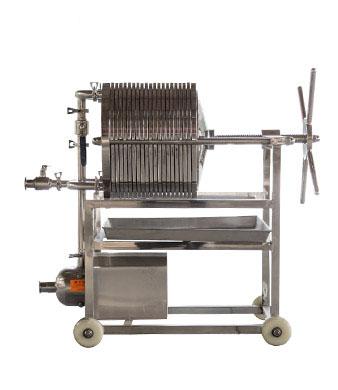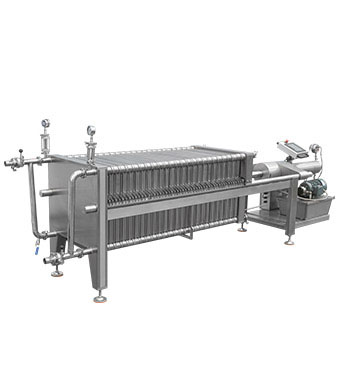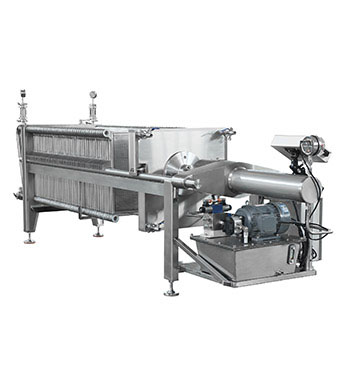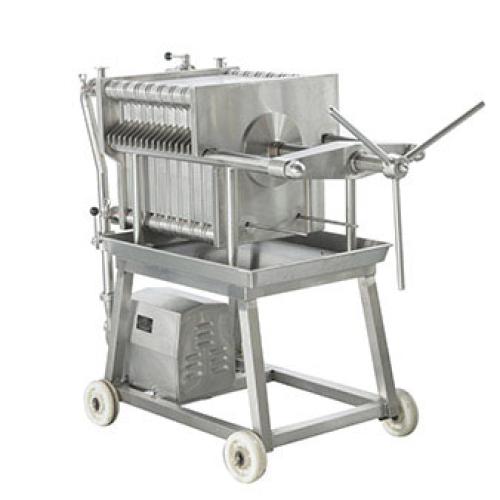

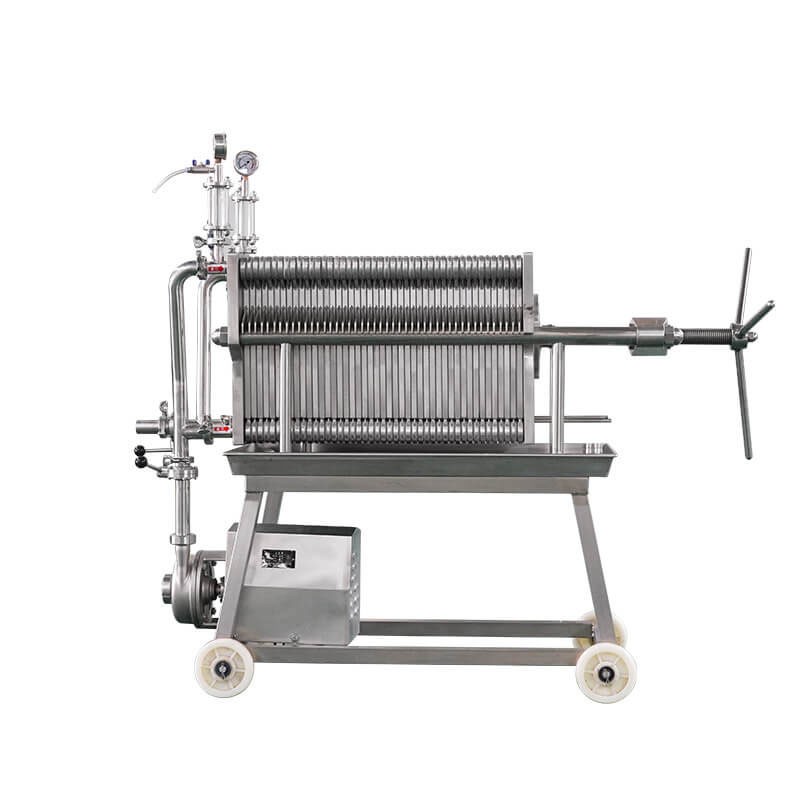
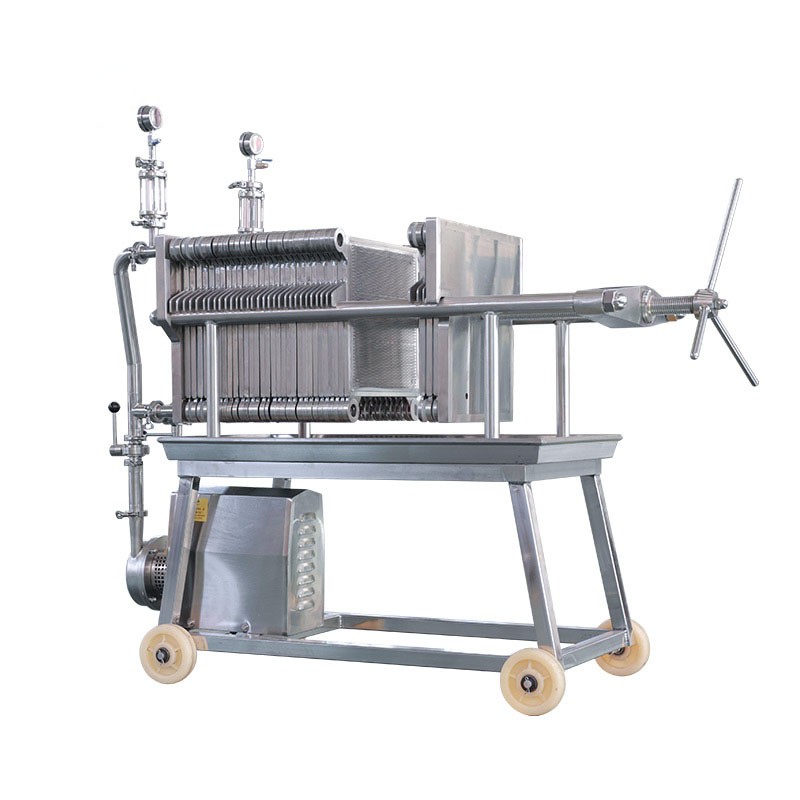
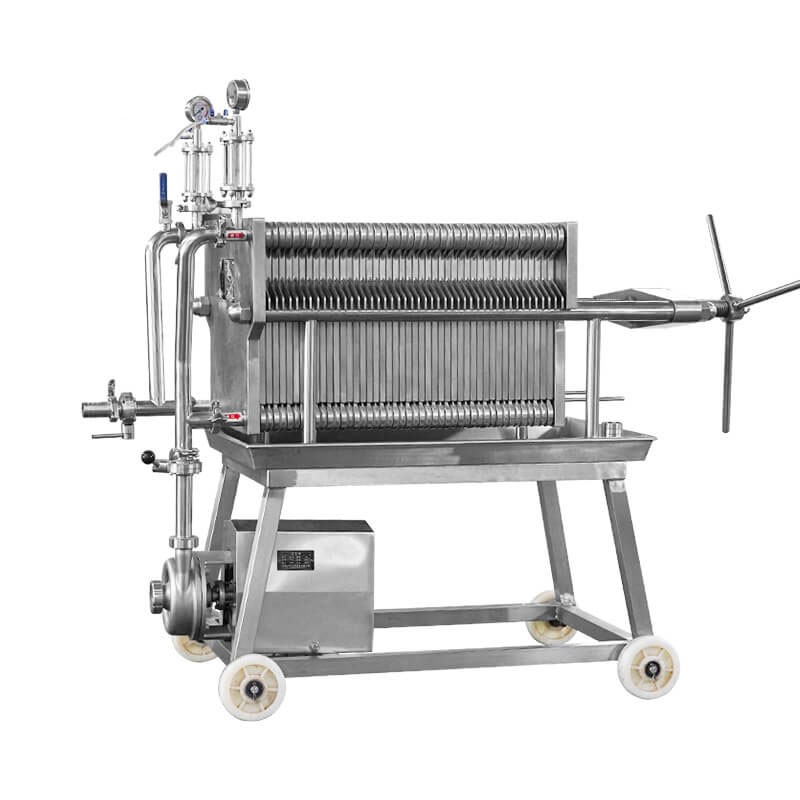
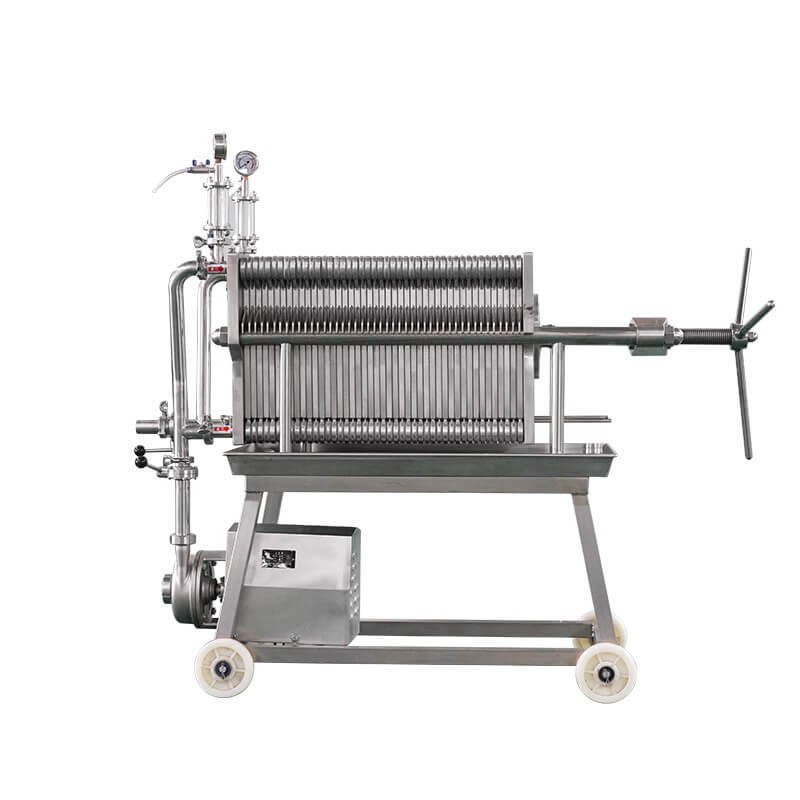
Manual Stainless steel plate and frame filter press for Beer, Wine
- S.S.304 (S.S.316 is selectable)
- Food Grade Silicone Rubber
- 0.4 MPa
- ≤ 120 °C.
- 13 mm; Individual Chamber Volume: 4.8 L.
- Screw/Manual Hydraulic (Others: Manual Jack/Automatic Hydraulic etc..)
- Description
- Specifications
Description
A stainless steel filter press is a device that combines coarse and fine filtration functions and is designed to separate the solid and liquid phases in various suspensions. The key requirement is selecting different filtration types according to the user’s specifications for the final product, which enables decarbonization, clarification, and sterilization, and can also be used for sludge retention and water removal. It is widely used in medicine, the food and chemical industries, environmental protection, water treatment, and other sectors.
Features
Principle and Structure
- Frame material: 304 stainless steel; plate frame material: 304 stainless steel (or 316L, as selected);
- Seal ring material: white silicone rubber;
- Working pressure: < 0.4 MPa;
- Working temperature: < 120 °C;
- Main dimensions: filter plate thickness 13 mm, filter frame thickness: 13 mm, volume of a single filter frame: 4.8 L;
- Pressing method: screw and manual hydraulic pressing (others, such as jacks, automatic hydraulics, etc.);
- Applicable filter media: various thick filter boards, various thin filter papers, filter membranes, filter fabrics, etc.
- Degree of filtration: Suitable for filter media ranging from filter cloth with 200- and 300-mesh apertures for coarse filtration to 0.22 µm and 0.45 µm for fine filtration, as well as filter paper and filter membranes.
- The stainless steel plate-and-frame fine filter has four corner ports for liquid flow through the four corners of each filter plate; however, only the two vertical corner ports on one side are connected to the interior of the the filter frame without a perforated plate). During filtration, the material is fed through the two corner openings on one side of the filter frame, and after passing through the filter layer (filter media), the clarified liquid exits through the two corner openings on the sides of the filter plate. The filtration residue remains in the filter frame, forming a filter cake, which achieves the separation of the solid phase from the liquid.
- Thin-layer cardboard filter: The plate and frame are pressed into a flat shape, making it suitable for clamping thick filter cardboard—such as a support plate, pre-filter plate, fine filter plate, sterilization plate, etc.—with a thickness of 3–5 mm.
- Plate-and-frame diatomaceous earth filter: By expanding the filter frame to 25–40 mm, the frame’s volumetric capacity is increased. After the support plate is clamped between the plate and the frame, filter media such as diatomaceous earth or activated carbon is pre-applied to them for filtration.
- Depending on requirements and the actual filtration volume, the dimensions of the filter plate and frame can be adjusted independently, or the number of filter plate layers can be increased to adapt to production needs. Various filter membranes can also be replaced to achieve optimal filtration performance.
Applications
The stainless steel filter press is suitable for closed-loop filtration of liquids with a concentration below 50%, low viscosity, and low sediment content, enabling it to meet the requirements of fine and semi-fine filtration, such as purification, sterilization, and clarification. Filtration through a microporous membrane filter achieves the goal of sterile filtration.
It is widely used in the production of liquid pharmaceuticals (traditional medicine extracts and other pharmaceutical filtration), infusion solutions, and oral liquids in the pharmaceutical industry; in winemaking, fruit juice production, beverages, and mineral water; soy sauce, vinegar, edible oil, honey, and syrup; in light industry; and for clarifying and filtering liquids in the petroleum, chemical, metallurgical, and electronics industries, as well as in environmental protection and other sectors.
Technical Specifications
| Model | Filter | Number of plates | Flow capacity (t/h) | Plate size (mm) | Overall dimensions (mm) |
|---|---|---|---|---|---|
| BASJL400-2 | 2 | 15 | 1–2 | 400×400 | 1250*660*1300 |
| BASJL400-3 | 3 | 21 | 1-3 | 400*400 | 1350*660*1300 |
| BASJL400-4 | 4 | 31 | 3-4 | 400*400 | 1550*660*1300 |
| BASJL400-6 | 6 | 45 | 4-6 | 400*400 | 1750*660*1300 |
| BASJL400-8.5 | 8.5 | 61 | 6–8 | 400×400 | 2100×660×1300 |
| BASJL400-9.5 | 9.5 | 71 | 8–10 | 400×400 | 2300×660×1300 |
| BASJL600-14 | 14 | 41 | 10-13 | 600*600 | 17504870+1350 |
| BASJL600-21 | 21 | 61 | 15-20 | 600*600 | 2100*870*1350 |
| BASJL600-24 | 24 | 71 | 20–25 | 600 × 600 | 2250 × 870 × 1350 |
| BASJL600-35 | 35 | 101 | 25–30 | 600*600 | 2800*870*1350 |